This page was translated from the Italian original with AI assistance.
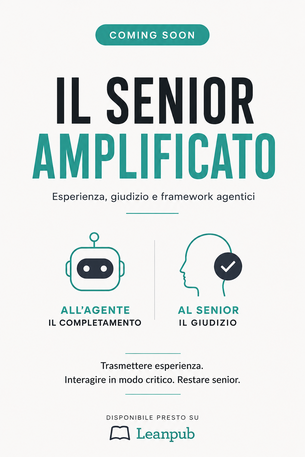
Why this book
This book is not about language models.
It is about engineering judgment, and how it can be amplified without being delegated.
AI changes the tools. Judgment remains the most valuable asset a Senior Software Engineer has.
The thesis
Core statement
Agentic engineering is not about replacing the Senior's work with an agent — it is about designing an operating model in which execution can be delegated without delegating judgment, accountability, and the capacity to learn.
Promise to the reader
The book gives people who already know how to build software a coherent way to work with agents without giving up their craft.
Consequences to be proven
- Code is no longer the only visible unit of engineering work.
- The mandate becomes the unit of delegation.
- Verification becomes part of the design, not a final phase.
- Memory must hold decisions and relationships, not just conversations.
- Autonomy is proportional to the quality of the mandate, the guarantees, and the stop conditions; it scales with risk.
- The Senior moves from continuous execution to verifiable direction, without becoming a passive observer.
- Amplification becomes cumulative when the outcomes of judgment persist and, retrieved in the right context, sharpen the project's rhythm over time.
Boundary
The book does not argue that every activity should be delegated. It describes how to decide what to hand off, under which limits, with which checks, and under which stop conditions.
Part 1 · The model
The Senior–agent operating model, argued in the abstract: judgment, mandate, verification, persistence, rhythm. No tool named — what stays true as the technology changes.
Part 2 · Building the rails (the harness)
The model turned into a machine: the five systems of the harness that keep the agent following the method. In each chapter, the invariant first, then the real instance this book was written with.
Appendices
This is a preview. The complete draft of the chapters is available on request for copy, editors, and reviewers. The book will be published on Leanpub.